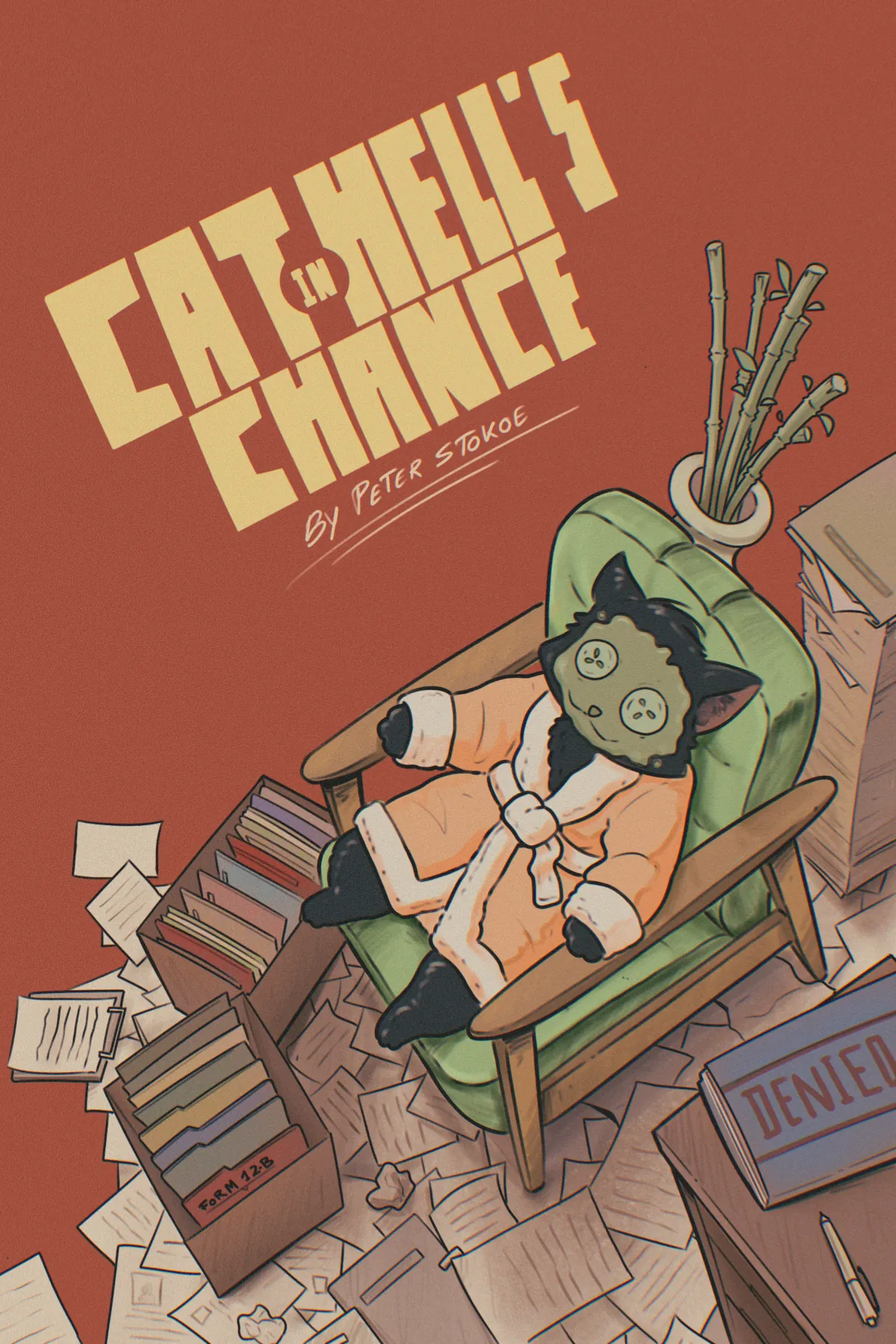
The new novel
Cat in Hell’s Chance
by Peter Stokoe
His cat's been declared dead. She's fine. He isn't. A deadpan afterlife caper.
Erwin Callahan receives a letter saying his cat, Frank, has been declared dead. Frank, noisily eating her breakfast, disagrees.
By the end of the day, Erwin's belongings have been auctioned off against his will. Nobody can see him except a stranger in a hat, who bids on all of it and then explains that Erwin is the one who is dead. By morning, a long-delayed death certificate arrives, along with a brochure explaining that the afterlife is entered through the walk-in cooler of the nearest liquor store.
Living pets are not permitted, but Erwin brings Frank anyway.
Awaiting them are lines that vanish into the distance, a cat-loving ferryman, a Hades rebranded as a health spa, and a Department of Appeals whose motto is clear: We do not make mistakes.
They run into Nora, who has died twice and been flagged for archival once, which is cold storage for people. She's on the run from things that look like ferrets in suits. The only person who can help them is an ancient woman who doesn't work for free. Her price is a job, and she'll be keeping something until it's done.
Death is final. Paperwork isn't.
A deadpan afterlife caper for fans of Douglas Adams and Terry Pratchett.
November 2026
- Paperback ISBN
- 978-1-0681476-1-6
- Ebook ISBN
- 978-1-0681476-0-9
Read the beginning
A sample from Cat in Hell’s Chance.
Chapter 1 - The Letter
The light came through a gap in the curtains, in a way that suggested they had given the matter some thought and decided against helping. Erwin woke to the rasping tongue of his cat, Frank, who was attempting to lick the sunlight off his face.
By the time Erwin had shuffled into the kitchen, Frank was trying to kill a letter that had invaded the mat below the mail slot. A row of porcelain cat statuettes was arranged neatly on the clean counter. He’d gotten them at a flea market on a work trip to another city; one of them reminded him of Frank. He opened a can of cat food and filled the dish with fish-flavoured brown mush, and Frank promptly abandoned the letter. She trotted over, gave Erwin a look that conveyed agitation at having to wait, and began gobbling the food the moment the dish touched the floor.
As she ate, Erwin went over and picked up the letter. It was from the city and addressed to him. Opening it, he read: We regret to inform you that the licence for your pet cat, Frank, has been terminated. Reason: Death.
He read it again. Erwin glanced at the cat, who was noisily eating her breakfast. Awfully hungry for being dead. This was the most ridiculous thing he’d heard all day—well, he’d just gotten up—all week then. Surely this was a mistake.
Through the window in the door he could see his neighbour across the street, mowing his lawn. Erwin felt the need to share this madness with somebody else, so he crossed the street. The neighbour stopped the mower and bent down to remove a clump of grass. He flung it towards the flower bed, then looked to see which flowers he’d crushed.
“They’ve decided that Frank is dead,” said Erwin, as he approached, waving the letter. “The cat,” he added, in case the man with the mower had forgotten.
Satisfied with the state of his flowers, the neighbour started the mower again, displaying no interest in Erwin or his cat. It was, Erwin reflected, about as much as he’d ever gotten out of this particular neighbour. He sighed and turned to go back towards his house. Frank, her breakfast now complete, was sitting in the window licking her paws.
Back in the kitchen, Erwin began making his own breakfast. This letter was clearly an error, and resolving it would require a trip to city hall. The line wasn’t something he looked forward to, but if he didn’t get this sorted it would only get worse. He stroked the back of Frank’s neck while waiting for his toast, pondering the easiest way to get to city hall. The toast popped and he spread some jam on it, then chewed thoughtfully. The bus was better than walking all the way, and the city was probably going to need to see evidence of a live cat. He’d have to take Frank with him.
Toast finished, Erwin changed out of his pyjamas. He worked remotely but had the day off, so today was better than most days to deal with this. He grabbed Frank and slid her into a backpack that doubled as a carrying case. Checking he had everything, he strode out the door and towards the bus stop.
As he came around the corner to the stop, the bus was pulling up. He waved frantically as he hurried to catch it, but the bus did not wait. Typical. He sat and glanced down at Frank, who returned an expression resembling a commiserating shrug and went back to licking herself. Fortunately, it was late spring, and the weather was pleasant. The kind of weather that was good for a picnic, if you didn’t have to be inside all day or have buses to catch just to stand in line somewhere. In this weather, at least, the bus schedules were even occasionally adhered to.
A short time later, a young woman arrived at the stop, wearing headphones and bobbing her head slightly. He smiled as she glanced towards where he was sitting; she didn’t return it or acknowledge him. So instead he watched a group of ants constructing an anthill under the bus shelter as they efficiently and collaboratively undermined the structure above.
His wait lasted only another half hour.
As the bus doors opened, he flashed his pass at the bus driver, who took no notice. Moving down the aisle, he passed by the usual collection of misfits that an off-peak bus contained. He sat down somewhere near the middle and waited for the bus to reach his stop.
Several people got off the bus at city hall. Erwin was one of them. The building was a large expanse of smooth concrete—except for the parts decorated by birds—and adorned with unimaginative rows of tiny windows.
Inside, a directory was mounted on the wall, organized by someone who believed any two things could share a department if you were firm enough about it.
Land use, construction permits, and hunting licences—no.
Weddings, funerals, divorces, and other reversals—no.
Garbage collection, missing children, and pet licences—yes.
The combinations of services made sense to somebody, somewhere, but not to Erwin and not here.
Erwin arrived at a counter that bore a sign explaining that the occupant would return in fifteen minutes. It didn’t say from when. Beside it, a machine dispensed numbered tickets, and Erwin took one, which read four. A screen on the wall said NOW SERVING FOUR, although, given the significant burn-in, it might have been saying that for a while. He waited next to a man holding a four, a woman holding a four, and a ticket dispensing machine that had clearly been installed to manage expectations rather than queues.
Erwin waited and nobody returned. He waited longer, and still nobody returned. An additional victim arrived and took a ticket, which also said four. Deciding that the fifteen minutes must have been in a time system he didn’t subscribe to, he opted to go in search of anyone who worked here.
He followed a smaller sign pointing him towards Pets, down a corridor, which delivered him to another sign, which delivered him to a third. The building had been laid out on the principle that anyone who truly needed something would keep walking and that anyone who didn’t would give up. Either result was acceptable to it.
It was a long corridor, but eventually he found the door he was looking for. There was a sign indicating it was the office of pet affairs and another, more prominent one, that said: Closed Tuesday—Staff Event. He stood there for a moment anyway, while he considered whether it was easier to just wait here until tomorrow. Instead, he looked down at Frank and said, “Well, I guess you stay dead for another day. Let’s go home.”
Frank chirped apologetically.
As Erwin rounded the corner before his house, he saw a group of men removing items and loading them onto a truck. He continued walking for a moment until he realized that it was his house they were removing items from. This wasn’t something he’d asked for; he had no plans to move. Was he being burgled? In broad daylight?
He hurried over and said, “What is the meaning of this?”
Frank hissed from within her carrier.
Erwin received no reply, so he put himself between the men and the truck to block their path. They moved around him as if he weren’t there. Not unkindly. The way water goes around a stone, having no opinion about the stone.
He pulled out his phone and dialled the police. “The number you have dialled is not in service,” came the reply. Did the police forget to pay their phone bill? Erwin checked the local news and looked for any service announcements from the city. There was nothing out of the ordinary. The men continued going in and out, removing bits of his life and putting them on the truck. A voice from inside cut through his confused dismay. He went in to find out what was going on.
The house was arranged for an auction. That was the only way to describe it. The furniture had been pushed to the edges or removed entirely, but many items were missing, or perhaps already sold. The remaining items were tagged and grouped, and a small crowd of people had gathered around them in a way that suggested somebody had told them where to stand. Erwin had not told them where to stand. Erwin had not requested an auction. Erwin very much wanted them to go away and leave him alone.
One of the home invaders gestured at his sofa, saying, “—one hundred going once, one hundred going twice. Sold! To the man in the hat.”
“What is going on here? This is my house!” yelled Erwin towards the auctioneer. He received no response from him or anyone else. Nobody even looked his way. The auctioneer casually continued, moving towards Erwin’s collection of porcelain cat statuettes.
“Here we have a porcelain cat statuette. A lovely piece, classic form, intact. Shall we start at five?” The pause as he looked at the item again suggested he had presided over better lots. “Five dollars.”
“Five dollars,” said Erwin. “I paid forty dollars each for those.”
The man in the hat nodded.
“I have five, will anyone give me ten?” continued the auctioneer. Nobody would, it seemed. “Sold, five dollars!”
Frank shifted in the carrier. Erwin was unsure whether she was searching for a better position or concerned about the statuettes.
“Well, now, here is a nice item.” The auctioneer indicated a rug with geometric shapes. “Let’s start the bidding at fifty dollars.”
Item after item was hauled out to the truck, despite Erwin’s occasional and vocal protests. By now, most of his things had been sold, and he was slowly realizing that it was the same person buying everything. The man in the hat and the long cloak. Well, Erwin thought it was a man; it was hard to tell with the way he was dressed.
“Why’re you buying my things?” said Erwin to the hatted man. No reply. “These are my things.” No reply. He stepped closer. “What are you going to do with them?”
“Pipe down,” said the figure in the hat. “I can’t hear the auction.”
Erwin was taken aback by finally getting a response. Recovering, he said, “But why the auction at all? I didn’t arrange this. These are my things.”
“Were your things. You’re dead.”
“I’m… what? Clearly I’m alive. I’m talking to you.”
“You are talking to me. You are also dead. Both of these can be true.”
Erwin considered his day. The municipal office. The bus. The men loading the truck. The complete absence of anyone who had looked at him directly. He seemed more invisible than usual today.
Erwin stepped over to one of the people in his house and said, “Excuse me.” No reaction. He tried again, louder. Nothing. He waved his hand in front of their eyes. No reaction. He stuck out his tongue, pulled down his eyelids, and jumped up and down. He might as well have been invisible.
Erwin returned and said, “Why are you able to see me?”
“You’re here, aren’t you?” said the figure. “Why wouldn’t I be able to see you?”
“Everyone else seems to be ignoring me.”
“Maybe they aren’t interested in what you’re saying.”
The last few items were removed from his house. The auctioneer and the small crowd of other potential buyers wandered out too. Outside, the truck door latched shut, and the truck pulled away from his house.
“But what am I supposed to do now?” Erwin said as he glanced around his emptied house.
The figure considered this for a moment as if they knew an answer and were deciding whether it would be useful to provide it. “You’ll figure it out.”
“Who are you?”
“Null.”
The answer wasn’t as helpful as he’d hoped, and at this point the last person was leaving his house. Erwin watched them go as they closed the door behind them. His gaze returned to where Null had been, but there was nobody there. The door had not opened, nor had he heard movement.
Erwin looked around, confused. How could somebody just vanish like that? He noticed a sign on the door, stuck to inside of the window, facing outwards. He strode over and ripped it off. Auction Today—Estate of Erwin Callahan.
Erwin dropped the paper, slid the backpack containing Frank off his shoulder, set it on the ground, then opened it. He slumped down and stared at his empty house, little piles of dust and fur clumped where the furniture had been. Everything he had was just taken from him.
He studied his hand; he didn’t think he was dead, but after today he was certainly feeling like he might be.
Frank crawled into his lap and began to purr.
It was, for the moment, the most useful thing anyone had done all day.